

Bitcoin difficulty adjustment 13 November: −7.1% expected
The estimate for 13 November moved from −3.65% to −7.11%. What that earns a home miner and where the electricity price limit now sits.
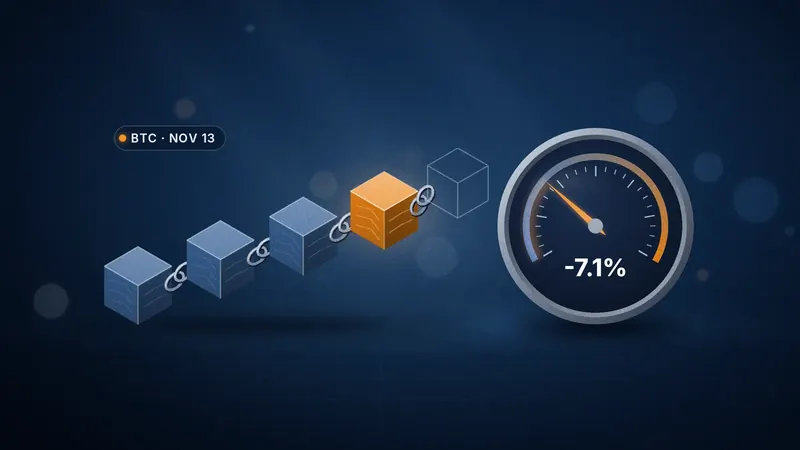
The estimate for the next bitcoin difficulty adjustment has almost doubled in a week: from −3.65% on 3 November to −7.11% at the time of writing on 10 November (14:12 UTC). The adjustment comes at block 975,744, which mempool.space puts at around 21:12 UTC on 13 November 2026. Difficulty would then fall from 148.36 T to about 137.81 T (T stands for 10¹²). At an unchanged price, a home miner will then earn 7.7% more bitcoin per day. It would be the biggest drop since 14 June 2026 (−10.09%).
Bitcoin difficulty on 13 November in short
- What is coming: at block 975,744 the network adjusts the difficulty. At the time of writing the chain stood at block 975,304, so 440 blocks to go.
- How much: the mempool.space estimate is −7.11%, from 148.36 T to about 137.81 T. That is an interim reading, not a result: the estimate shifts with every new block.
- What has changed: our article of 3 November said −3.65% and 13 November at around 08:29 UTC. Now it is −7.11% and around 21:12 UTC.
- Why: in this period blocks are arriving every 10 minutes and 46 seconds on average, rather than every 10 minutes. So less computing is being done than the difficulty expects.
- What it earns per miner: at an unchanged price, after the adjustment a miner earns 7.7% more bitcoin per day (1 ÷ 0.9289 = 1.0766).
- The catch: the price has fallen in the meantime, so in euros the gain is smaller than the percentage suggests. And above roughly €0.109 per kWh, a Bitaxe Gamma loses money on electricity alone.
What exactly is going on?
Difficulty determines how much work a miner has to do, on average, to find a valid block. The network adjusts it every 2,016 blocks, aiming for one block every ten minutes, so 14 days per period. If blocks come faster, difficulty goes up; if they come more slowly, it goes down.
The current period began on 29 October 2026 at 19:14 UTC (block 973,728). At the time of writing, 1,576 of its 2,016 blocks have been found in 11 days and 19 hours. At a pace of exactly ten minutes, that would have taken 10 days and 22 hours, so the period is running about 20 hours behind. On 3 November the delay was still about 25 minutes. The pace has therefore slowed further since then, which is why the estimate has moved so much.
The figures for computing power itself are rough. The daily values from mempool.space for 4 to 8 November range between 0.955 and 1.077 ZH/s (zettahash, 10²¹ hashes per second). On 9 November it reads 0.826 ZH/s and on 10 November 0.825 ZH/s, but that last day was not over at the time of writing. A single daily value says little; the pace of the blocks is the measure the network itself uses.
Note that the estimate has been known to move further than you might expect. Our article of 28 October assumed +6.50%; it came in at +5.54%. So this time too, work with a range rather than a single figure. If the estimate holds, 137.81 T is still 3.8% higher than in the period that began on 3 October (132.72 T).
What does a home miner earn after 13 November?
The yield follows a fixed formula: bitcoin per day = hashrate (in H/s) × 86,400 × block reward ÷ (difficulty × 2³²). With a block reward of 3.125 bitcoin, 1 TH/s comes to 42.37 satoshi per day at the current difficulty of 148.36 T, and about 45.62 satoshi at 137.81 T. Transaction fees hardly count: in the 144 blocks from 975,161 to 975,304 inclusive, 0.69% of what miners received came from transaction fees (3.11 of 453.11 bitcoin).
Below are the same three devices as in our article on buying a Bitaxe at three shops, with the hashrate and power as the shops state them. It is a worked example, not a promise: it assumes a price of 66,000 euros per bitcoin (mempool.space, 10 November 2026, 14:05 UTC), an unchanged price and 30 days per month. On 3 November that price was 69,126 euros, so it is 4.5% lower now.
What you are left with depends on your electricity price. The limit above which you make a loss is the daily yield divided by the kWh the device uses per day:
An example: after the adjustment the Gamma earns €1.17 per 30 days and uses 10.8 kWh. At €0.25 per kWh that electricity costs €2.70, so you are €1.53 out of pocket. It only pays off below €0.109 per kWh, and even then without counting the purchase price. The €0.25 is an assumption, not a measured price; enter your own tariff. You can read more about what a home miner earns in Mining bitcoin at home in 2026: what a 12 TH/s miner really earns. For the devices on sale, see home miners and Bitaxe devices.
Solo mining with a device like this remains a lottery: the chance of finding a block is small and the outcome is all or nothing. The comparison with renting hashrate is in Rent hashrate or buy a Bitaxe? The sums for 2026.
What does this mean for you as a European investor?
If you already have a miner. First look at your electricity price per kWh and compare it with the limit in the table. The power figure the shop gives is only an indication; measure it yourself with a plug-in power meter. You can follow the difficulty yourself on mempool.space.
If you are considering a miner. Work with the difficulty of the next period, not just the current one, and do not wait for a drop in the hope of a better moment: difficulty has gone both up and down this year, and a 7% drop is gone again within two weeks if computing power returns. With a yield of €1.17 to €7.23 per 30 days, before electricity costs, a purchase price of €87.87 to €445.55 (see the article on prices at three shops) is not quickly earned back.
Electricity prices differ by country. In the EU, consumer tariffs vary widely. Find your own tariff on your energy bill and work with the price per kWh including tax and VAT.
Tax. What you have to declare on mined bitcoin differs by country and is not what this article covers. See crypto tax in Europe.
What is not certain yet
- The adjustment itself. −7.11% is a mempool.space estimate at the time of writing. It changes with every block as the block pace changes; there are still 440 blocks to go, a good three days. The timing (around 21:12 UTC on 13 November) shifts with it. The actual adjustment may turn out lower or higher.
- The price. The tables assume 66,000 euros per bitcoin. A different price changes the euros, not the satoshi.
- The power draw of your device. The shops give different figures for the same chip. Measured consumption differs from the stated figure.
- Why there is less computing power. Difficulty shows that blocks are arriving more slowly, not why. We have not established that cause in the sources.
This article is not investment advice. Crypto can fall sharply in value and you can lose your entire stake.
Frequently asked questions
When is the next bitcoin difficulty adjustment?
According to the mempool.space estimate, on 13 November 2026 at around 21:12 UTC, at block 975,744. That time shifts with the pace of the blocks.
Will bitcoin difficulty fall on 13 November?
At the time of writing (10 November 2026) the estimate is −7.11%, from 148.36 T to about 137.81 T. The outcome is only settled once block 975,744 has been found.
How often is bitcoin difficulty adjusted?
Every 2,016 blocks, roughly every two weeks. The last adjustment was on 29 October 2026 (block 973,728).
Will my Bitaxe earn more now that difficulty is falling?
Yes. After an adjustment of −7.11% it earns 7.7% more bitcoin per day at an unchanged price. In euros it also depends on the price.
Is mining bitcoin at home still worth it?
That depends on your electricity price. With a 15 W Bitaxe Gamma the limit after the adjustment is about €0.109 per kWh, at a difficulty of 137.81 T and a price of 66,000 euros. Above that, you lose money on electricity alone.
Sources
Read on 10 November 2026.
- mempool.space: estimate of the next adjustment (as of 10 November 2026, 14:12 UTC)
- mempool.space: difficulty adjustments, latest periods (29 October 2026, block 973,728)
- mempool.space: hashrate, last week (as of 10 November 2026)
- mempool.space: block reward and transaction fees, last 144 blocks (block 975,161 to 975,304 inclusive)
- mempool.space: bitcoin price (10 November 2026, 14:05 UTC)
- Cryptocode: buying a Bitaxe, three shops with hashrate and power as stated by the shops (14 October 2026)
Prices of the coins in this article

Mid-market price from CoinGecko in euros, updated at 15:50 UTC.All 20 prices