EBA report on stablecoins in DeFi: what does it say?
The EBA published a report on stablecoins in DeFi on 25 November 2026: USDC leads, there are risks for you and advice for the Commission.
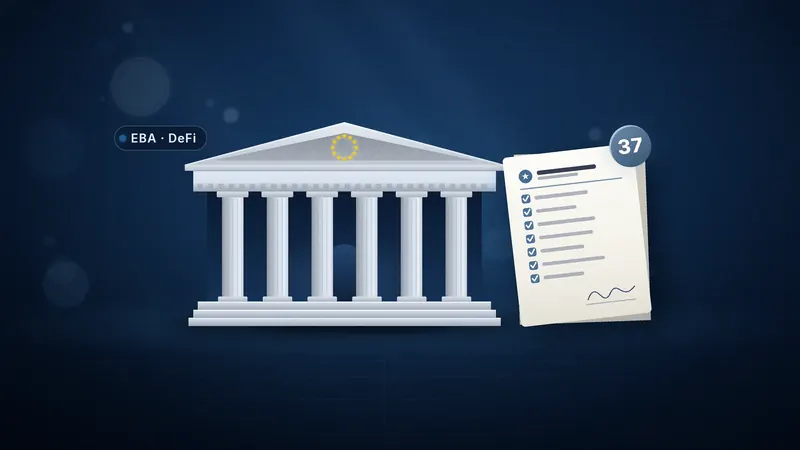
The European Banking Authority (EBA) published a report on 25 November 2026 on the use of e-money tokens (EMTs) and other stablecoins in decentralised finance (DeFi), reference EBA/Rep/2026/22. The main finding: stablecoins are the lubricant of DeFi, USDC is the most widely used MiCA token, and the EBA asks the European Commission to examine whether providers that steer clients towards DeFi need extra rules. The report bans nothing. It describes risks and gives advice for the MiCA review.
Stablecoins in DeFi in short
- Size: DeFi is a small part of the crypto market. According to the report, the value locked in DeFi protocols is roughly 3% of total crypto market capitalisation. In July 2026 that was 75 billion dollars, half of the peak in autumn 2025.
- MiCA tokens: as of July 2026, ESMA's MiCA register lists 37 e-money tokens and not a single asset-referenced token (ART).
- USDC leads: of the MiCA tokens, USDC is by far the most used on the decentralised exchanges and lending protocols studied.
- European users: the EBA says involvement of EU users remains limited. Germany, France and Spain top the EU.
- Access is getting easier: some providers (CASPs) let clients reach DeFi through their own app, and AI assistants lower the threshold further.
- Risks: you can lose everything through leverage, defaults, technical errors or a hacked protocol. There is usually no complaints procedure or redress.
- Advice: the EBA repeats that the Commission should consider whether extra requirements are needed for providers that give access to DeFi lending protocols.
What the EBA looked at
In the first half of 2026 the EBA looked at six blockchains (Ethereum, Tron, Solana, BNB Smart Chain, Base and Hyperliquid), four decentralised exchanges (Uniswap, Aerodrome, PancakeSwap and Hyperliquid) and six lending protocols (Aave, Morpho, Fluid, Spark, Compound and JustLend). The figures in the report are as of 30 July 2026, unless stated otherwise.
DeFi falls outside the scope of MiCA as long as services are provided without an intermediary and in a fully decentralised way. Staking, borrowing and lending also fall outside the current text of the regulation. In the consultation on the MiCA review (20 May to 31 August 2026), the Commission asked whether that should change. Want the background to that review? Read what France wants for DeFi and stablecoins and what ESMA wants to tighten.
Which stablecoins are used
The report sets out the figures per token. Market capitalisation is as of July 2026.
On USDT, the report says it is by far the largest stablecoin in DeFi. What that means for your exchange is covered in what to do with USDT before 8 January 2027. We wrote about EURCV earlier in EURCV on Kraken, and about USDC and EBA supervision in USDC as a significant e-money token.
Why people do it: yield
The EBA names the search for yield as the main reason for using stablecoins in DeFi. A stablecoin pays no interest by itself. Lent out or deposited through a protocol, it can earn a return. The report gives the average annual yield (APY) for people depositing on Morpho, July 2026:
A worked example: 1,000 euros at 3.49% earns 34.90 euros in a year, at 2.60% it earns 26.00 euros. That is a difference of 8.90 euros. These are averages from a single month, not a guarantee, and they say nothing about the risk that the protocol fails. The gap between 4.15% and 2.60% is therefore no reason in itself to pick one.
MiCA prohibits issuers and providers from paying interest on e-money tokens. The EBA sees a risk that this ban is circumvented: some providers present access to DeFi as a way to “earn” with stablecoins. The protocol then pays the yield, not the provider, but the client still comes in through the provider. That is why the EBA wants the Commission to include this in the review.
What can go wrong
The EBA names three kinds of risk and gives two examples from 2026.
- For you as a user: there is no mandatory risk disclosure up front as there is with an authorised provider, leverage can be large, a loan in stablecoins may not be repaid, and self-custody in your own wallet brings technical risks. Complaints handling and redress are usually absent.
- For issuers and providers: if a protocol collapses that holds a large share of a stablecoin, holders may want to redeem en masse. That loss of confidence can also hit the issuer.
- For supervisors: in DeFi they often cannot see who is doing what, or in which country, which makes rules easy to circumvent.
The two examples from the report:
- Drift (April 2026): an attack on the Solana protocol Drift cost roughly 285 million dollars, a large part of which was converted into USDC. It remained possible to move that USDC and it went to Ethereum. Circle was criticised for freezing too slowly. After the restart, Drift switched from USDC to USDT.
- Sky and USDC: in July 2026 the Sky protocol held 4.5 billion dollars of USDC in reserve, roughly 9% of all USDC on Ethereum (50 billion dollars). The EBA uses this to show that a DeFi stablecoin and the stablecoin behind it are tied to each other.
Lending is also growing. The value of active loans in DeFi rose from 9 billion dollars at the start of 2024 to 26 billion dollars on 30 July 2026, after a peak of more than 50 billion dollars in September 2025.
What does this mean for you as a European investor?
The report is not a rule, so nothing changes in what you are allowed to do. It does show what supervisors are looking at, and that helps when you see an “earn” or “DeFi” button in an app.
Ask who provides the service. A provider with a MiCA authorisation must, under Article 66(3), warn you about the risks of transactions in crypto-assets. Check the register of authorised providers to see who is behind the app. For DeFi itself, according to the EBA, there is no mandatory risk disclosure up front.
Know who pays the yield. Is it the provider, or a protocol your money is sent to? In the second case your deposit sits in a smart contract. Find out whether you can get it back, and what happens if the protocol is hacked.
Choose your own wallet deliberately. For DeFi you usually need your own wallet. A mistake or a fake connection cannot be undone. How to choose a wallet is covered in choosing a crypto wallet.
Mind the country. The EBA names Germany, France and Spain as the EU countries with the most DeFi interaction, but these are estimates based on web traffic and wallets. It also says those countries rank low internationally: Germany is 18th, France 19th and Spain 26th, behind India (1st), the US (2nd) and the United Kingdom (12th), among others. Tax on DeFi income differs by country; see crypto and tax in Europe for what we can say per country, with sources.
What is not certain yet
- Not a rule: the Commission does not have to adopt the advice. The report does not say when or how the MiCA review would regulate DeFi access.
- Estimates: nobody can say exactly how many EU users are in DeFi. The EBA uses surveys and estimates from Chainalysis and TRM Labs, which have limitations of their own.
- Snapshot: the figures are as of July 2026. Yields and market values have changed since.
- Where DeFi ends: MiCA does not define “fully decentralised”. According to an ECB working paper, in many protocols power sits with a few holders of governance tokens, developers and sometimes exchanges.
This article is not investment advice. Crypto can lose a lot of value and you can lose your entire stake.
Frequently asked questions
Does the EBA ban DeFi or stablecoins in DeFi?
No. The EBA publishes an analysis and repeats advice to the European Commission. There is no ban or new rule in it.
Which stablecoin is most used in DeFi?
USDT is the largest (184 billion dollars market capitalisation in July 2026). Of the MiCA tokens, USDC is by far the most used, at 73 billion dollars.
Can a European provider pay interest on USDC?
No, MiCA prohibits issuers and providers from paying interest on e-money tokens. The EBA warns that access to DeFi can work as a detour, and wants the Commission to include that in the review.
What is an e-money token (EMT)?
A stablecoin that tracks a single official currency and is permitted under MiCA, such as USDC or EURC. See also what are stablecoins.
Are my stablecoins safe if they are in DeFi?
The report cannot answer that. The EBA points to risks from leverage, unrepaid loans, technical errors and hacks, and to the lack of complaints handling or redress.
Sources
Read on 28 November 2026.
- EBA, press release “EBA examines the use of stablecoins, including EMTs, in decentralised finance”, 25 November 2026
- EBA, Report on the use of EMTs and other selected stablecoins in decentralised finance, EBA/Rep/2026/22 (pdf), November 2026
- EBA, response to the Commission's consultation on the MiCA review (pdf), 24 September 2026
Prices right now


Mid-market price from CoinGecko in euros, updated at 06:50 UTC.All 20 prices