Volksbank and Raiffeisenbank: 73 banks notify crypto
73 German Volksbanken and Raiffeisenbanken are in the ESMA register with crypto order services. What that means, what you can buy and what to check.
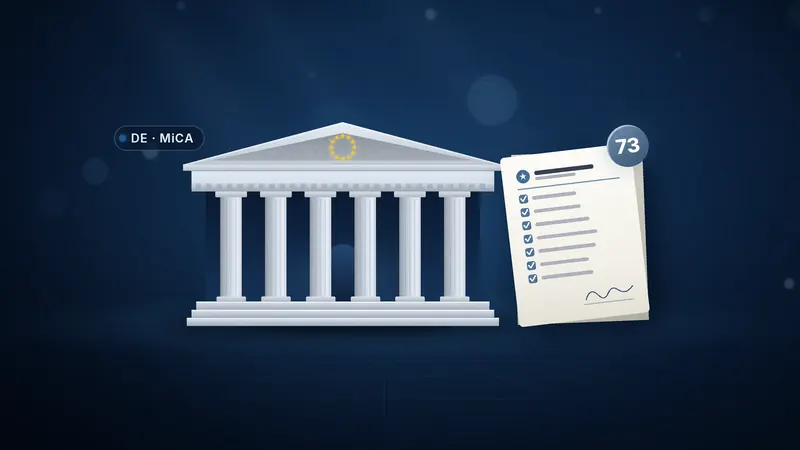
At the time of writing, the ESMA register lists 73 German Volksbanken and Raiffeisenbanken that execute crypto orders for clients, alongside their central bank, DZ BANK. In 2025 there were 8, the first two on 5 November; 65 more followed in 2026, including three with a date after 24 November. These are notifications under Article 60 of MiCA, not separate authorisations: a bank that already holds a banking licence notifies its supervisor, here BaFin, of its crypto service in advance.
Volksbanken and MiCA in short
- 73 banks with Volksbank, Raiffeisenbank, VR Bank or Sparda-Bank in their name have a notification in the ESMA register (list of 24 November 2026 read; counted by name).
- One service: all 73 notify the execution of orders for clients (service e). One bank, Volksbank Raiffeisenbank Bayern Mitte, also notifies the reception and transmission of orders (service g).
- The central bank: DZ BANK notifies custody, execution and transfer of crypto for clients (notification of 23 December 2025, last updated on 2 March 2026).
- The product: according to the Genossenschaftsverband Bayern, the offering is called ‘meinKrypto’, a wallet in the VR Banking App for clients who make their own decisions, without investment advice.
- The offering at launch: bitcoin, ethereum, litecoin and cardano. Custody by Boerse Stuttgart Digital, execution via EUWAX (report of 24 March 2026).
- Please note: a notification means the bank is allowed to offer it, not that your bank already does. Check your own bank’s website or app.
What a notification under Article 60 is
In the EU, a crypto-asset service provider (CASP) normally needs its own MiCA authorisation. Banks that already hold a licence can take a cheaper and faster route: they notify their crypto services to their supervisor in advance and are then listed in the same ESMA register. The register calls this ‘Article 60 – Notification’. That is why we write ‘notification’ and not ‘authorisation’, as we also do in our MiCA register.
This is not a detail. At the time of writing, the register has 409 entries, of which 166 are Article 60 notifications. Germany accounts for 123 of them, almost three quarters, out of 131 German entries in total.
How fast it went: notifications per month
The date is the notification date in the ESMA register. The figures are counted from ESMA’s CASPS.csv file, read on 24 November 2026.
The pace was highest in August. For November, 11 notifications up to and including 24 November carry a date in that month, plus the one dated 25 November. A date after the day of writing appears in the register as it stands; ESMA does not explain in the file what that date exactly means (effective date or registration date).
What you can do with it as a client
The offering comes from one shared source: DZ BANK and Atruvia, the group’s IT provider, built ‘meinKrypto’. The banks each join it individually. According to the Genossenschaftsverband Bayern (report of 24 March 2026), the participating banks do not actively promote it and only execute orders from clients who want it themselves. The association does not expect a rush.
A bank is different from an exchange:
If you want to buy bitcoin in an ordinary banking environment, this is one route. If you want to send it to your own wallet, you will need to ask your bank. You can find an overview of providers in our comparison, and how to choose a wallet in the wallet guide.
We have written before about Buy bitcoin at Sparkasse: 0.99 euros plus a markup. The Sparkassen work with an offering of their own; the notifications in this article concern only the Volksbanken and Raiffeisenbanken.
What does this mean for you as a European investor?
In Germany. If you have an account at a Volksbank or Raiffeisenbank, first look up your bank in the ESMA register or in our register. If your bank is listed, check in the VR Banking App or with your adviser whether ‘meinKrypto’ is open to you. If your bank is not listed, that is the state of the register at the time of writing, not a judgement on the bank; a notification may still follow.
Outside Germany. The Volksbanken and Raiffeisenbanken are a German group. In the Netherlands, Belgium, France, Spain, Portugal and Poland the same MiCA rules apply, but the notifications in this article are German. Banks in other countries, where they notify, are listed under their own supervisor in the same register.
Tax. Buying through a bank does not change the tax rules of your country. How crypto is taxed in each country is explained on our page on crypto tax in Europe.
What is not certain yet
- Costs. We found no official prices for ‘meinKrypto’ from the banks themselves. Ask your own bank about the costs (markup and fixed fees) beforehand.
- Who is already live. The register shows notifications, not who already offers the service to clients. According to the report of 24 March 2026, Bayern Mitte was then the only Bavarian cooperative bank with bitcoin wallets. We could not confirm how many banks now offer it to clients.
- The dates after 24 November. Three notifications (25 November, 3 and 7 December) carry a future date in the register. ESMA does not say what that date means.
- The legal text. The EUR-Lex page could not be opened from our environment at the time of writing; the explanation of Article 60 follows the description in the ESMA register and our own register page.
- The number of banks. We counted by name (Volksbank, Raiffeisenbank, VR Bank, Sparda-Bank). A cooperative bank with a different name, such as the Münchner Bank, is not included in the 73.
This article is not investment advice. Crypto can fall sharply in value and you can lose your entire stake.
Frequently asked questions
Can you buy bitcoin at a Volksbank?
At a bank that has a notification in the ESMA register and has activated ‘meinKrypto’, you can, via the VR Banking App. According to the Genossenschaftsverband Bayern, the banks do not actively promote it. Ask your own bank.
Does a Raiffeisenbank have a MiCA authorisation?
Not as a separate authorisation. Banks notify their crypto service to the supervisor under Article 60 of MiCA and are then listed as a notification in the ESMA register.
Which coins can you buy through meinKrypto?
At launch, bitcoin, ethereum, litecoin and cardano (report of 24 March 2026). We could not confirm whether coins have been added since.
How many Volksbanken take part?
The ESMA register lists 73 banks with a notification, counted by name, alongside DZ BANK. That is more than the 8 from the end of 2025.
Sources
Read on 24 November 2026.
- ESMA, register of crypto-asset service providers (CASPS.csv), file with latest change of 18 November 2026, read on 24 November 2026
- IT Finanzmagazin, Atruvia und DZ-Bank: Erste Volksbanken rollen „meinKrypto” aus, 24 March 2026
- BTC-ECHO, Erste Volksbanken in Deutschland erhalten MiCA-Lizenz, 14 November 2025
- BTC-ECHO, Volks- und Raiffeisenbanken kündigen Krypto-Handel an, 21 July 2025
Prices of the coins in this article

Mid-market price from CoinGecko in euros, updated at 14:40 UTC.All 20 prices