Buy bitcoin at Sparkasse: 0.99 euros plus a markup
Since 19 October, five Sparkassen sell bitcoin and four other coins in their app: 0.99 euros per order plus a markup of over 1.3%. No own wallet allowed.
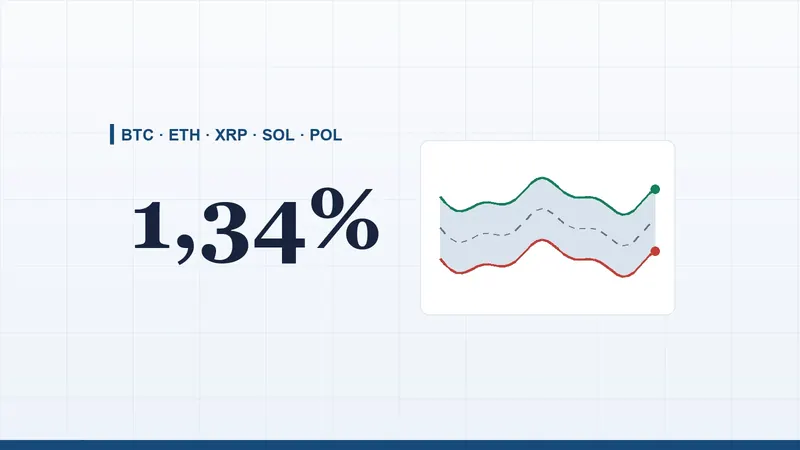
Since Monday 19 October, customers of the first Sparkassen have been able to buy bitcoin, ether, XRP, solana and POL in the App Sparkasse. The product is called Krypto – powered by Deka and comes from DekaBank, the Sparkassen’s investment house. On 19 October, DekaBank’s list included five of the 339 Sparkassen; according to their umbrella organisation, the DSGV, 30 to 40 more will join every month. An order costs 0.99 euros, plus a markup that DekaBank does not state as a figure: in the bank’s own trade reports, the buying price of bitcoin was 1.34% above the market price.
Sparkasse and bitcoin in short
- Five coins: bitcoin (BTC), ether (ETH), XRP, solana (SOL) and POL, Polygon’s coin.
- Five Sparkassen at launch: Frankfurter Sparkasse, Taunus Sparkasse, Sparkasse Karlsruhe, Sparkasse Rottal-Inn and Niederrheinische Sparkasse RheinLippe. Each Sparkasse decides for itself when to join.
- Costs: 0.99 euros per purchase or sale; custody is free. On top of that, DekaBank charges its own markup (spread).
- Markup measured: in the transactions from 21 September to 16 October inclusive, the buying price of bitcoin was 1.34% above the market price and the selling price 1.35% below it.
- Not to your own wallet: transfers are only possible to four designated crypto companies. Depositing crypto from elsewhere is not possible.
- Germany only: you must be 18, live exclusively in Germany and be liable to tax there.
- No advice, no active advertising: the DSGV calls crypto ‘hochspekulative Anlagen’ (highly speculative investments) and warns of total loss.
What you can do at the Sparkasse
In the App Sparkasse, under ‘Anlegen’, you open a crypto account. Your contractual counterparty is DekaBank, not your Sparkasse. You need a current account at a participating Sparkasse and online banking with an electronic mailbox, and you may not use the account for business purposes.
To place an order, you request a price. DekaBank shows a binding price; your order at that price stays open for at most ten seconds. DekaBank sells you the coins from its own holdings. There is no minimum per order; the maximum is 250,000 euros. As a rule, the coins are in your crypto account by the second banking day at the latest. Trading is possible almost all the time, except during maintenance: every day from 23:30 to 00:30 and on two Saturdays a month from 13:00 to 15:00 (German time). If the app goes down, an emergency line lets you sell, but nothing else.
According to the price information of September 2026, registration, custody, transfers and statements are free. The price is a market price with DekaBank’s own spread on top; for large amounts or in very turbulent markets, DekaBank can adjust that spread.
DekaBank holds the coins itself, for all customers together in a single wallet, and keeps a record per customer of what belongs to whom. Under the German crypto law (KMAG), the coins count as the customer’s property and fall outside any insolvency of the bank. There is no deposit guarantee or compensation scheme. According to a press release of 13 October 2025, Boerse Stuttgart Digital ensures that DekaBank can buy in enough crypto. By accepting the terms, you also allow DekaBank to show your crypto holdings to your adviser at the Sparkasse.
How big is the markup?
Since 19 September, DekaBank has published its completed transactions every day, with time, coin, quantity and price, as MiCA (Article 77) requires. Up to and including 16 October, there were 560 transactions, worth 18,067.71 euros in total. The largest was 500.53 euros. Who traded is not stated; the public launch was on 19 October.
We compared each price with the one-minute price on the Bitstamp exchange and checked some of them against Coinbase:
These are the median values per coin. For POL the comparison is less precise, because little POL is traded on Bitstamp. An example: on 15 October at 10:49 German time, someone sold bitcoin at 71,453 euros per coin; just over a minute later, someone bought at 73,374 euros. At that moment the price on Bitstamp, Coinbase and Kraken was around 72,430 euros. The difference between the buying and selling price: 1,921 euros, or 2.65%.
What that costs when you buy, with the 1.34% markup on bitcoin:
The markup is the amount multiplied by 1.34 and divided by 101.34: the part of your money for which you get no bitcoin. If you buy for 1,000 euros and sell again straight away at an unchanged price, you get back 972.47 euros after paying the order fee twice: 28.52 euros less than the 1,000.99 euros you paid.
What you cannot do: own wallet, deposits, staking
- Transfers only to four companies. According to the list of October 2026: Crypto Finance (Deutschland), Tangany, Boerse Stuttgart Digital Custody and Bullish Europe. Transfers to other addresses, including your own wallet, are not possible. They are free, usually take up to three banking days and are possible from 0.0001 bitcoin.
- No keys. The private keys stay with DekaBank.
- No deposits. Sending crypto from elsewhere to DekaBank is only possible for institutional clients.
- No staking. The terms list four services: buying and selling, executing orders, custody and transfers.
- No coins from forks or airdrops. You have no right to them.
Why that matters: you depend on DekaBank and the app. If you switch to a bank that does not take part, or your Sparkasse stops offering the product, DekaBank may terminate your contract. You then have to sell within eight weeks or have your coins transferred to one of those four companies; if you do nothing, DekaBank may pay out their value in euros after sending a reminder. If you want to hold your coins yourself, you need an exchange that allows withdrawals to your own address, and a wallet. How to choose one is explained in choosing a crypto wallet.
Sparkasse or crypto exchange: the costs side by side
What exchanges charge per order and per withdrawal is on our comparison page. Who is authorised, and in which countries, is in our MiCA register.
DekaBank is listed in the ESMA register (version of 16 October 2026) with two notifications to BaFin under Article 60: as of 1 December 2025 for custody, executing orders and transfers, and as of 25 June 2026 for exchanging crypto for money. Such a notification is the route for banks; the difference from an authorisation is explained in MiCA register: authorised or just notified?
The Sparkassen are not the first. The same ESMA version lists 56 German cooperative banks, such as Volksbanken and Raiffeisenbanken, with a notification for crypto services. Deutsche Bank is listed with a notification for custody and transfers, dated 12 October; according to CoinDesk, citing Reuters, the bank will start custody for business clients within a few weeks. In Switzerland, a cantonal bank already put crypto trading straight into its banking app in July. How banks are buying in custody is explained in European banks are buying their way into crypto custody.
What does this mean for you as a European investor?
Outside Germany you cannot use the product: DekaBank requires you to live exclusively in Germany. That rules it out in France, Spain, Portugal and Poland too.
Germany. Check whether your Sparkasse is on DekaBank’s list. DekaBank does not withhold tax and reports your transactions every year to the Bundeszentralamt für Steuern, the federal tax office. If your gain from private sales stays below 1,000 euros a year, it is tax-free, according to DekaBank (as of 2026).
Netherlands. bunq offers crypto in its own banking app through Kraken, from 1 euro, with ‘fees from 0.25% per transaction’. The trading runs through Payward Europe Solutions, which is listed in the ESMA register with the Central Bank of Ireland as its supervisor (25 June 2025).
Belgium. KBC sells bitcoin and ether through its investment platform Bolero, for 0.50% per order with a minimum of 5 euros. KBC holds the coins. Withdrawing to your own wallet is only possible under certain conditions; crypto from elsewhere cannot be moved to Bolero. KBC Bank is listed in the ESMA register under the National Bank of Belgium.
Austria. Raiffeisen, in Salzburg among other regions, offers Bitpanda in the Mein ELBA app, from 1 euro. You then become a customer of Bitpanda, not of Raiffeisen; Raiffeisen receives a fee from Bitpanda for this. Bitpanda is listed in the ESMA register with a CASP authorisation from the FMA (9 April 2025).
What is not certain yet
- The markup after launch. Our measurement covers transactions from before 19 October, with amounts of up to 500 euros. DekaBank can adjust the markup. The app shows the costs before you confirm.
- The pace. Each Sparkasse decides for itself. The DSGV wants a large share of the interested Sparkassen to be connected in the first half of 2027.
- More coins or a savings plan. DekaBank can extend or shorten the list of coins. The terms do not mention a savings plan for private customers.
- Your own wallet. Ruled out for now. DekaBank does not say whether that will change.
- Deutsche Bank. An exact launch date is not known.
This article is not investment advice. Crypto can fall sharply in value and you can lose your entire stake.
Frequently asked questions
Can I buy bitcoin at Sparkasse?
Yes, if your Sparkasse takes part, you are 18 and you live exclusively in Germany. On 19 October that applied to five Sparkassen; according to the DSGV, 30 to 40 more will join every month.
How much does it cost to buy bitcoin at Sparkasse?
0.99 euros per order, plus a markup. In DekaBank’s trade reports, the buying price of bitcoin was 1.34% above the market price. For 100 euros, that comes to 2.31 euros in total.
Can I send my bitcoin from Sparkasse to my own wallet?
No. Transfers are only possible to Crypto Finance (Deutschland), Tangany, Boerse Stuttgart Digital Custody and Bullish Europe.
Is crypto at Sparkasse covered by the deposit guarantee?
No. According to DekaBank, crypto is not covered by the statutory deposit guarantee. The coins are, however, kept separate from the bank’s own assets.
Sources
Read on 19 October 2026.
- DekaBank: MiCAR page with price information, terms, customer and consumer information, execution policy, the list of permitted recipients and the daily reports from 19 September to 18 October 2026.
- DekaBank: Krypto – powered by Deka and participating Sparkassen, 19 October at around 10:45 German time.
- Boerse Stuttgart Digital: press release, 13 October 2025.
- DSGV: Fakten und Aufgaben, 339 Sparkassen as of 1 January 2026.
- dpa-AFX via Ariva, 19 October 2026.
- ESMA: interim MiCA register, CASPS.csv, version of 16 October 2026.
- One-minute prices in euros: Bitstamp, Coinbase and Kraken.
- CoinDesk, 18 October 2026.
- bunq, Bolero, Raiffeisen Salzburg.