DAC8 self-certification: what to do before 1 January 2027
DAC8 has applied since 1 January 2026. Exchanges must ask existing customers for their tax residence before 1 January 2027. Here is what to know.
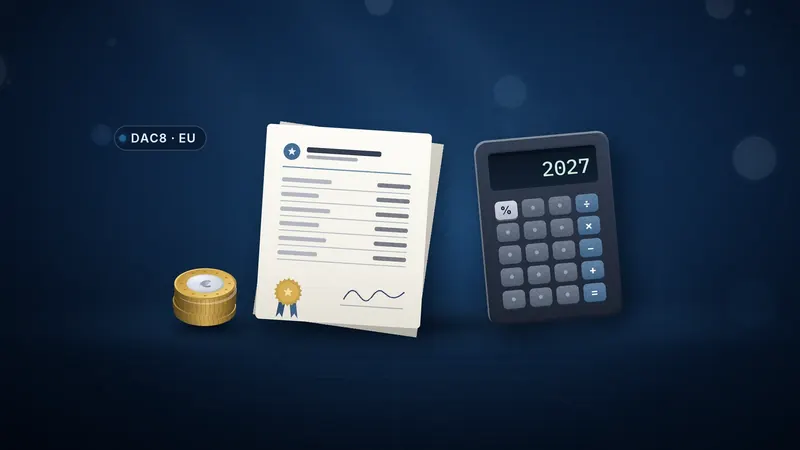
Since 1 January 2026, the EU's DAC8 directive has been in force: crypto providers now collect data on the transactions of their EU customers and report it in 2027 to the tax authority of their own country. For customers who already had an account before 2026, the directive requires the provider to have recorded their tax residence by means of a self-certification no later than 1 January 2027. At the time of writing, that is just over five weeks away. If you do not respond to your exchange's request, the directive text says it can block you from trading.
DAC8 in short
- What it is: the eighth amendment to the European directive on administrative cooperation in tax matters (Directive (EU) 2023/2226). Member States automatically exchange data on crypto, as they already did for bank accounts.
- Since when: the rules apply from 1 January 2026. The directive was adopted on 17 October 2023 and published on 24 October 2023; Member States had to transpose it into national law before 31 December 2025.
- Who reports: ‘reporting crypto-asset service providers’ (RCASPs): exchanges, brokers and other providers that carry out exchange transactions in crypto, including those outside the EU that serve customers here.
- What you have to do: provide a self-certification stating your tax residence and your tax identification number (TIN). New customers do this when opening an account, existing customers by 1 January 2027 at the latest.
- First reporting year: 2026. The provider reports in 2027; by 30 September 2027 at the latest, countries exchange the data on non-resident customers (European Commission).
- What it is not: a new tax. DAC8 is about reporting and exchanging information, not about how much you pay. How crypto is taxed in your country is set out in your national law.
What your exchange needs from you
The directive (Annex VIII, Section III) says the provider must obtain a self-certification that establishes in which country you are tax resident, and that it must check whether this is reasonable, among other things on the basis of what it already knows about you from its identity checks. For an individual, the self-certification is only valid if you have signed or otherwise confirmed it, it is dated, and it contains the following details:
- first name and surname;
- residential address;
- the Member State or Member States in which you are tax resident;
- your tax identification number (TIN) for each Member State in which you are liable to tax;
- your date of birth.
Companies and other legal entities provide different details: name, address, country of tax residence, TIN and, unless it is an active entity, also details of the persons who control it. If something changes in your situation, for example a move to another country, the provider may no longer use your old self-certification and must ask for a new one.
What gets reported
The provider reports totals per calendar year and per type of crypto, not a list of every individual transaction. The first reporting year is 2026. According to Annex VIII, Section II, this includes the following:
The provider also reports your name, address, country of residence, TIN and date of birth. A worked example (made-up figures, for illustration): if in 2026 you buy bitcoin three times for 500, 700 and 800 euros and sell once for 1,200 euros, the report for that coin shows a total amount paid of 2,000 euros (3 transactions) and a total amount received of 1,200 euros (1 transaction). The provider does not calculate your profit.
Which national reporting deadlines are known and how the amounts per client are added up is covered in our earlier article DAC8 crypto reporting: what exchanges send tax authorities.
What happens if you do not respond
In Annex VIII, Section V, the directive requires Member States to oblige providers to enforce the self-certification. If a customer does not provide the requested details after two reminders following the initial request, and no earlier than 60 days after it, the provider must prevent the customer from carrying out reportable transactions. In practice, that could mean you can only buy, sell and withdraw again once you have completed the form. How each provider sets this up depends on national law and on its own terms and conditions, so check your own account or email.
Each country sets its own penalties for infringements. The directive only asks that they be ‘effective, proportionate and dissuasive’.
How to check this
- Go to your account yourself. In the app or on your exchange's website, look for ‘tax information’, ‘tax residency’, ‘DAC8’ or ‘CARF’. A genuine request will be there too.
- Do not click blindly on an email. Scammers can imitate a tax request. Open the site or app yourself, as described in our crypto security checklist, and never enter your password, seed phrase or 2FA code for a tax form.
- Find your tax number. Your TIN is usually on your tax assessment or on your tax authority's website. If you live in more than one country, you will need more than one.
- Check your details. If your address or country is no longer correct in your account, update it first.
- Do you have accounts with several providers? Then you will receive the request from each of them. A provider may use a self-certification it has already collected for another tax purpose, if it meets the same requirements.
- Keep what you fill in. The provider must keep its steps and data for at least five and at most ten years; that gives you a reason to keep a copy yourself too.
What does this mean for you as a European investor?
The rules are European, but implementation is national. The European Commission itself writes that providers must check the national requirements, including reporting deadlines and file formats. For you as a customer, it comes down to this:
- If you are resident in an EU country: your provider reports your data to the tax authority of the country where it is established or registered; that authority passes it on to the country where you live, by 30 September 2027 at the latest for the year 2026.
- If you use a provider outside the EU: DAC8 also applies to providers outside the EU that serve customers here. They must register in a Member State. There is also an international framework, the OECD's CARF, for which, according to the European Commission, 76 countries had already announced in March 2026 that they wanted to exchange data, most of them from 2027.
- If you only use your own wallet: a self-custodied wallet is not reported under DAC8. As soon as you buy, sell or send crypto to that wallet through an exchange, however, the provider does see those actions.
- The tax itself differs per country. The fact that DAC8 gives data to your tax authority says nothing about how you declare your crypto. For that, see our guide to crypto taxation in Europe.
If you want to know whether your exchange is authorised in the EU, look it up in our MiCA register. If it has a notification or authorisation, you are not yet free of DAC8: banks that offer crypto, such as the 73 German Volksbanks and Raiffeisenbanks, can also have reporting obligations.
What is not certain yet
- National law and date. The European Commission gives 1 January to 30 September 2027 as the reporting period; the exact date per country and the file format are set out in national legislation. We have not read every country's national laws.
- The 60 days and the reminders. The directive text mentions two reminders and a minimum of 60 days. How your exchange applies this and from when it blocks trading, we have not been able to check with every provider.
- What counts as ‘crypto’. The directive builds on the MiCA definition. According to the European Commission, stablecoins, e-money tokens and certain NFTs also fall within its scope; however, the directive's annex excludes ‘electronic money’ as defined there. If in doubt, what your provider and your tax authority say applies.
- Whether your provider has already contacted you. Each provider chooses its own moment; some have already asked, others have not.
This article is not investment or tax advice. Crypto can lose a lot of value and you could lose your entire investment.
Frequently asked questions
What is DAC8?
DAC8 is the eighth amendment to the European directive on administrative cooperation in tax matters. Since 1 January 2026, crypto providers have reported data on their customers and transactions to the tax authority, which exchanges it with other EU countries.
Do I have to do anything before 1 January 2027?
Yes, if you were already a customer before your provider started applying DAC8: the directive requires it to have a self-certification from you by 1 January 2027 at the latest. A new customer provides it when opening the account.
What does a self-certification contain?
For an individual: name, residential address, the Member State or Member States in which you are tax resident, your tax identification number (TIN) per Member State and your date of birth, signed or confirmed and dated.
What happens if I do not respond?
According to the directive, after two reminders and no earlier than 60 days, the provider must prevent you from carrying out reportable transactions. How this works in your account differs per provider.
Does DAC8 also report my self-custodied wallet?
No, DAC8 obliges providers to report, not individuals with their own wallet. Actions carried out through a provider, such as a withdrawal to your wallet, do fall under its reporting obligation.
Sources
Read on 25 November 2026.
- European Commission, DAC8: Directive on Administrative Cooperation (tax transparency for crypto-assets), read on 25 November 2026
- Directive (EU) 2023/2226 of 17 October 2023 (DAC8), EUR-Lex, Annex VIII, Sections II, III, IV and V, read on 25 November 2026
Prices right now


Mid-market price from CoinGecko in euros, updated at 06:40 UTC.All 20 prices