

Bitcoin difficulty adjustment 26 November: +11.8% expected
Bitcoin's difficulty is expected to rise 11.79% on 26 November. What that costs a home miner, with the sums for each device.
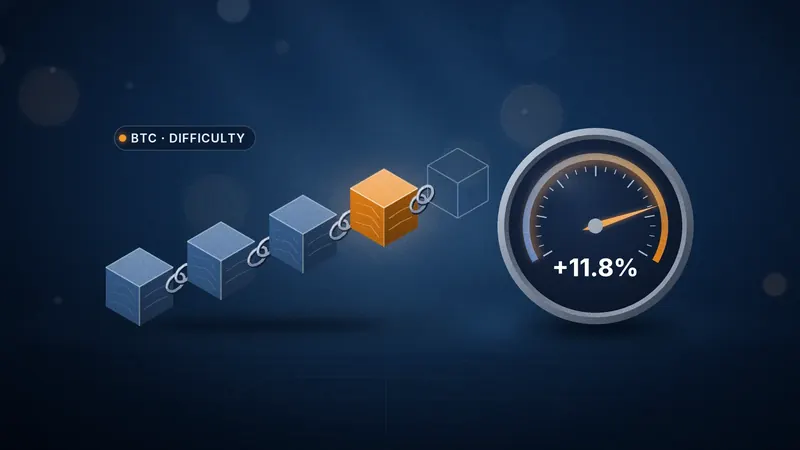
According to mempool.space's estimate, the bitcoin difficulty will rise by about 11.79% on 26 November 2026 at around 17:30 UTC, from 134.82 T to 150.72 T (T stands for 10¹²). On 14 November the estimate was still −5.56%. Since the adjustment of 14 November, blocks have been arriving faster than one every ten minutes, and at the same price a home miner will soon earn 10.5% less bitcoin per day. A Bitaxe Gamma would then bring in about €0.96 per 30 days, against €1.07 now.
Bitcoin difficulty adjustment on 26 November in short
- What is expected: at block 977,760 the network adjusts the difficulty, from 134.82 T to an estimated 150.72 T. That is +11.79% (mempool.space, as of 17 November 2026, 06:11 UTC at block 976,238).
- When: mempool.space's estimate is 26 November 2026 at 17:30 UTC. There are 1,522 blocks still to go. The outcome is only certain once block 977,760 has been found.
- Why up: the 494 blocks since the adjustment of 14 November arrived on average every 533 seconds instead of every 600. So more computing was going on than the difficulty expected.
- What it costs: at an unchanged price, a home miner earns 10.5% fewer satoshis per day (134.82 ÷ 150.72 = 0.8945).
- The biggest jump in months: a rise of 11.79% would be the largest since the +14.73% of 19 February 2026 (block 937,440). The adjustments in between ranged from −10.09% to +7.15%.
- The caveat: this is an estimate that moves with the pace of the blocks. On 14 November it stood at −5.56%, on 10 November at −7.11%.
What exactly is going on?
The difficulty determines how much work a miner has to do, on average, to find a valid block. The network adjusts it every 2,016 blocks, aiming for one block every ten minutes, so fourteen days per period. If blocks come more slowly, the difficulty goes down; if they come faster, it goes up.
The current period began on 14 November 2026 at 05:02:50 UTC with block 975,744, when the difficulty fell by 9.13%. Up to block 976,238 (17 November, 06:11:07 UTC), 494 blocks were found in 263,297 seconds, an average of 533 seconds per block. That is our own calculation, based on the timestamps of those two blocks. Mempool.space derives the expected change of +11.79% from this; exactly how it calculates that is not our calculation.
So the estimate has turned around in three days. In our article on the drop of 14 November we still gave −5.56% for this period, at the time of writing with 1,955 blocks to go. That was an early estimate, with well over 1,900 blocks still to go. After that, more hashrate came in, and the blocks sped up.
Mempool.space's daily figures for hashrate (in ZH/s, zettahash, 10²¹ hashes per second) show this: 0.81 on 14 November, 0.93 on 15 November, 1.15 on 16 November and 1.10 on 17 November, a day that was not yet over at the time of writing. On 11 and 12 November it was around 0.98 and on 13 November 0.90. A single daily figure says little; the pace of the blocks is the measure the network itself uses. The sources do not say why hashrate came back.
The estimate of 150.72 T is the current 134.82 T times 1.1179. That is higher than the 148.36 T of 29 October, the highest level in the table.
What will a home miner earn after 26 November?
The yield follows from a fixed formula: bitcoin per day = hashrate (in H/s) × 86,400 × block reward ÷ (difficulty × 2³²). With a block reward of 3.125 bitcoin, 1 TH/s comes to 46.63 satoshis per day at the current difficulty of 134.82 T and 41.71 satoshis at 150.72 T. Transaction fees hardly count: in the 144 blocks from 976,095 up to and including 976,238, 0.55% of what miners received came from transaction fees (2.47 of 452.47 bitcoin).
Below are the same three devices as in our article on buying a Bitaxe at three shops, with the hashrate and power as the shops stated them there. This is a worked example, not a promise: it assumes an unchanged price of €58,967 per bitcoin (mempool.space, 17 November 2026, 06:00 UTC) and 30 days per month. The “now” column uses 134.82 T, the “after” column 150.72 T.
So the number of satoshis falls by 10.5%. What bitcoin itself does comes on top of that: according to our article of 14 November the price was then €60,385; at the time of writing it is €58,967 (−2.3%).
What you keep depends on your electricity price. The break-even point above which you make a loss is the yield per day divided by the kWh the device uses per day:
An example: after the adjustment the Gamma earns €0.96 per 30 days and uses 10.8 kWh. At €0.25 per kWh that electricity costs €2.70, so you are €1.74 down. Only below roughly €0.089 per kWh does it pay, and that is still without counting the purchase price. The €0.25 is an assumption, not a measured price; enter your own tariff. More on what a home miner earns can be found in Mining bitcoin at home in 2026: what a 12 TH/s miner really earns. Which devices are on sale you can see at home miners and Bitaxe devices.
Solo mining with a device like this remains a lottery: the chance of finding a block is small and the outcome is all or nothing. The comparison with renting hashrate is in Rent hashrate or buy a Bitaxe? The sums for 2026.
What does this mean for you as a European investor?
If you already have a miner. Look at your electricity price per kWh and compare it with the break-even price in the table. The power the shop states is an indication; measure it yourself with a plug-in power meter. You can follow the difficulty yourself on mempool.space.
If you are considering a miner. Calculate with the difficulty of the next period, not just the current one. The difficulty has gone both up and down this year, and a rise of 11.8% can be gone again within two weeks if hashrate drops away. With €0.96 to €5.90 per 30 days, before electricity costs, a purchase price of tens to hundreds of euros is not quickly earned back.
Electricity prices differ per country. In the EU, consumer tariffs vary widely. Look up your own tariff on your energy bill and calculate with the price per kWh including tax and VAT.
Tax. What you have to declare on mined bitcoin differs per country and is not the subject of this article. See crypto tax in Europe.
What is not certain yet
- The outcome. +11.79% is an estimate by mempool.space at the time of writing, with 1,522 blocks still to go. Last time, the estimate of 10 November was more than two percentage points away from the outcome, and between 14 and 17 November this estimate jumped from −5.56% to +11.79%. So calculate with a range, not a single number.
- Why hashrate was added. The difficulty shows that blocks came faster, not why. We have not established that cause in the sources.
- The price. The tables assume €58,967 per bitcoin. A different price changes the euros, not the satoshis.
- Your device's power draw. In October the shops gave different figures for the same chip. Measured consumption differs from the stated figure. We have not re-checked these specifications with the shops for this article; they come from our article of 14 October.
This article is not investment advice. Crypto can lose a lot of value and you could lose your entire stake.
Frequently asked questions
When is the next bitcoin difficulty adjustment?
According to mempool.space's estimate at the time of writing, on 26 November 2026 at 17:30 UTC, at block 977,760. The time shifts with the pace of the blocks.
How much will the bitcoin difficulty rise on 26 November?
By an estimated 11.79%, from 134.82 T to 150.72 T. The outcome is only certain after block 977,760.
Will my Bitaxe earn less if the difficulty rises?
Yes. At the same hashrate and price, the yield falls by 10.5% in satoshis. According to our calculation, a Bitaxe Gamma would then earn €0.96 per 30 days, against €1.07 now.
Is mining bitcoin at home still worth it?
That depends on your electricity price. With a 15 W Bitaxe Gamma, the break-even after the adjustment is roughly €0.089 per kWh, at a difficulty of 150.72 T and a price of €58,967. Above that you lose money on electricity alone.
Sources
Read on 17 November 2026.
- mempool.space: estimate of the next adjustment, block 977,760 (as of 17 November 2026, 06:11 UTC)
- mempool.space: earlier adjustments, up to and including block 975,744 (14 November 2026, 05:02 UTC)
- mempool.space: hashrate, last week (as of 17 November 2026)
- mempool.space: block reward and transaction fees, last 144 blocks (block 976,095 up to and including 976,238)
- mempool.space: bitcoin price (17 November 2026, 06:00 UTC)
- Cryptocode: Bitcoin difficulty −9.1% on 14 November: home miner (14 November 2026)
- Cryptocode: Bitaxe price: what a home miner costs at three shops (14 October 2026)
Prices of the coins in this article

Mid-market price from CoinGecko in euros, updated at 06:40 UTC.All 20 prices