EU privacy coins ban: what changes on 10 July 2027?
From 10 July 2027, Article 79 bans anonymous crypto accounts at providers. The law does not name which coins fall under it.
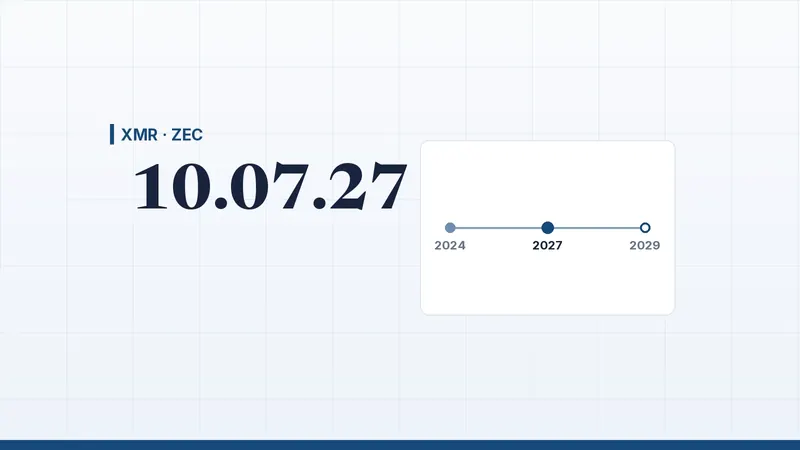
On 10 July 2027, the EU anti-money laundering regulation (AMLR, Regulation (EU) 2024/1624) starts to apply. Article 79 says that banks, financial institutions and crypto-asset service providers may no longer keep anonymous crypto accounts, nor accounts that allow transactions to be obscured, ‘including through anonymity-enhancing coins’. At the time of writing on 20 October 2026, that is 263 days away. The regulation does not name a single coin; which coins fall under it depends on the definition.
Privacy coins in the EU in short
- Date: the regulation was adopted on 31 May 2024 and applies directly in all member states from 10 July 2027 (Article 90).
- Who must comply: banks, financial institutions and crypto-asset service providers (exchanges, custodians). The ban is aimed at the provider, not at you as a holder.
- What is banned: keeping anonymous crypto accounts and accounts that make the customer or the transactions anonymous or subject to ‘increased obfuscation’, ‘including through anonymity-enhancing coins’.
- What an anonymity-enhancing coin is: a crypto-asset with built-in features to anonymise transfer data, ‘systematically or optionally’ (Article 2(1), point 25).
- What stays outside the ban: providers of hardware and software and of self-hosted wallets, as long as they have no access to or control over those wallets (recital 160).
- What the text does not do: it contains no list of coins and no provision that prohibits holding coins or transferring them between your own wallets.
What Article 79 says exactly
Article 79(1) is the core. It prohibits credit institutions, financial institutions and crypto-asset service providers from keeping anonymous bank and payment accounts, passbooks, safe-deposit boxes or anonymous crypto accounts, and also ‘any account allowing for the anonymisation of the account holder or the anonymisation or increased obfuscation of transactions, including through anonymity-enhancing coins’. Existing anonymous accounts may only be used once the customer has been identified (customer due diligence).
Two things stand out:
- The regulation talks about accounts, not about holding. The ban applies to whoever keeps an account or holds assets for a customer. Recital 160 says the ban does not apply to providers of hardware and software or of self-hosted wallets, insofar as they have no access to or control over those wallets.
- The definition is broad. Article 2(1), point 25, calls a coin anonymity-enhancing if it has built-in features to anonymise transfer data, ‘systematically or optionally’. That leaves room for a difference between coins where privacy is always on and coins where the user chooses it.
Timeline
What changes for an exchange?
An exchange with a MiCA authorisation is a crypto-asset service provider, and therefore one of the parties bound by the ban. What that means for its listings depends on how the supervisors apply the definition. Three scenarios, without a settled answer yet:
- Coins with transactions hidden by default: these clearly fall under the description ‘systematically’ anonymous. Exchanges will have to stop holding them for customers.
- Coins with optional privacy: according to the letter of the definition, these also fall under ‘optionally’. Whether an exchange may still offer the coin if customers do not use the privacy feature is not stated in the text.
- Coins without a built-in privacy feature: bitcoin and ether do not have one and so do not fall under the definition. The ordinary identification rules do apply to these coins.
For privacy coins, this is a European discussion, not a Dutch or German one. The regulation applies directly, without a member state first having to pass a law for it. We have written before about a Zcash ETP on Euronext in 21Shares launches Zcash ETP on Euronext, ZEC tops $1,500. An exchange-listed product is something different from an account at a crypto exchange; Article 79 is about the latter.
Identification from 1,000 euros
The same regulation also sets out when a crypto-asset service provider has to identify you. Article 19(3), point (a), says they carry out customer due diligence for an occasional transaction of at least 1,000 euros, whether in a single operation or in linked transactions. Below 1,000 euros, a lighter form of customer due diligence is enough (Article 20(1), point (a)). If you already have an account, this threshold changes little; if you are looking for a quick swap without an account, the anonymous route disappears.
What does this mean for you as a European investor?
If you hold privacy coins on an exchange. Expect exchanges to review their offering before 10 July 2027. If you currently keep coins on an exchange that fall under the definition, it is wise to know how that exchange handles them and what withdrawal options there are.
If you manage your own keys. The text of the ban is aimed at providers that keep or hold an account. It does not apply to providers of self-hosted wallets without access to the wallet (recital 160). The regulation does not prohibit holding coins in your own wallet. More on the choice between keeping coins on an exchange and holding them yourself can be found in choosing a crypto wallet.
If you want to know who you are dealing with. You can check whether an exchange may be a crypto-asset service provider in the MiCA register. You will find that in our overview of MiCA authorisations.
Tax. This article is not about tax. How to report gains on coins in your country can be found in crypto tax in Europe.
What is not certain yet
- Which coins fall under it. The regulation names no names. Monero and Zcash are often mentioned in the press, but the text itself does not decide on individual coins.
- How optional privacy is treated. The definition mentions ‘optionally’, but we have not found in the text how it applies to a coin that offers privacy as a choice. That will take implementing rules and supervisory practice.
- What exchanges will do. An exchange may do more than the minimum. We have found no primary source that gives a date or a list; reports on this are second-hand.
- Transitional period. Article 79(1) contains a rule for existing anonymous accounts (customer due diligence before use), but no separate wind-down period for coins that an exchange holds.
This article is not investment or legal advice. Crypto can lose a lot of value and you could lose your entire investment.
Frequently asked questions
Are privacy coins banned in Europe from 10 July 2027?
Not for holding. Article 79 prohibits crypto-asset service providers from keeping anonymous accounts and accounts with anonymity-enhancing coins. A ban on private individuals holding such coins or sending them between their own wallets is not in the text.
Are Monero and Zcash named in the law?
No. The regulation names no coins. It gives a definition of anonymity-enhancing coins, with features that anonymise transfer data, ‘systematically or optionally’.
When does the rule take effect?
On 10 July 2027, under Article 90 of Regulation (EU) 2024/1624.
Does this apply to bitcoin too?
Bitcoin has no built-in privacy feature to anonymise transfer data and so does not fall under the definition. The ordinary identification rules for providers do apply.
How much can I swap without identification?
For an occasional transaction of at least 1,000 euros, a crypto-asset service provider has to carry out customer due diligence (Article 19(3)). Below that, a lighter form of due diligence applies.
Sources
Read on 20 October 2026.
- Regulation (EU) 2024/1624 of the European Parliament and of the Council of 31 May 2024 (EUR-Lex, published 19 June 2024), Articles 2, 19, 20, 79 and 90 and recital 160.