Glamsterdam delayed: what it means for your ETH
Hoodi test of 26 October cancelled over gas risk to existing contracts. No new date, mainnet unscheduled. What ETH holders need to know.
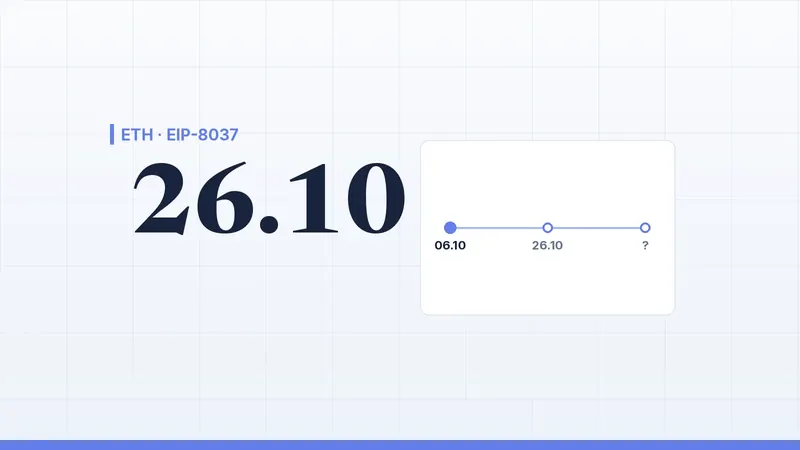
The Glamsterdam upgrade on the Ethereum test network Hoodi, scheduled for Monday 26 October 2026 at 17:42:48 UTC (18:42 Dutch time), is not going ahead. Developers decided this on 22 October during the ACDE #248 call, after an analysis of the new gas rules by security firm ChainSecurity. There is no new date, and for the mainnet, the real chain, there was no date to begin with. As an ETH holder, you do not need to do anything.
Glamsterdam delay in short
- What has been cancelled: the upgrade on Hoodi of 26 October 2026, 17:42:48 UTC (epoch 132,352). The Ethereum Foundation writes on 22 October that a new activation date has not been set.
- Why: research by ChainSecurity of 13 October shows that the new gas rules (EIP-8037 and EIP-8038) can make existing contracts react differently to a failed call. Some contracts could then still record a failure, where in the past they would have been rolled back.
- Also postponed: raising the gas limit on Hoodi to 200 million, which was part of the same fork.
- Mainnet: there is no date. The dates of 1 and 8 December from our earlier article were proposals, in case Hoodi went well; there is no basis for them any more.
- You as an ETH holder: do nothing. The Ethereum Foundation writes that this announcement concerns Hoodi and that Ethereum users and ETH holders do not need to do anything.
- The downside: the upgrade meant to make blocks bigger and the network faster is being pushed back. How far, nobody knows at the time of writing.
What was decided on 22 October
On 22 October the call of execution developers (ACDE #248) discussed ChainSecurity's findings. The outcome, as the Ethereum Foundation published it the same day: Glamsterdam on Hoodi is postponed to investigate further the interaction between EIP-8037 and smart contracts on the mainnet. The client configuration is being changed so that the 26 October activation, the 200 million gas limit and the Gloas activation on the consensus layer are removed. The history of the Hoodi chain stays as it was; only the planning for the future has been rolled back.
On the call, developer Ansgar Dietrichs set out three possible outcomes: the mainnet stays on schedule if everything is resolved in time; the mainnet is postponed with the same specification, to allow more time for analysis and countermeasures; or the Glamsterdam specification itself changes. Which one it will be depends on a full analysis of the consequences. The ethrex team remarked in the chat that the mainnet would therefore probably arrive in 2027. Dietrichs said he shares that estimate, but no decision has been made on it. For the mainnet, then, the position is: decision postponed until the analysis is finished.
In two weeks, in the week of the Devcon conference, there is no meeting of the execution developers (ACDE); the next one is in four weeks.
What ChainSecurity found
Gas is the unit of account Ethereum uses to calculate the cost of a transaction. Many contracts call other contracts and catch a failed call, to note that something failed or to carry on with a next step. If a call has failed because too little gas was supplied, a malicious party can exploit that: the contract then records an irreversible failure, even though the action would have succeeded with enough gas. Contracts protect themselves against this by checking after the call how much gas is left, or by relying on the error handling itself being too expensive to complete, so that the whole transaction rolls back.
According to ChainSecurity (blog of 13 October, based on the specifications of that date), EIP-8037 and EIP-8038 change those assumptions, even if the contract's code stays the same:
- Gas comes back. If an action creates new data and is then undone, the gas for that data is returned immediately, up to 97,920 gas. That can be enough to complete an error handler that would previously have stalled.
- A separate pool. Gas above 16,777,216 per transaction goes into a separate pool for creating data. How much gas is left then says less about what the transaction can still do.
- Higher prices. Writing to a new storage slot in a contract now costs 22,100 gas (cold). With Glamsterdam that is 12,100 plus 97,920 gas for creating data, 110,020 in total if the separate pool is empty: almost five times as much. A gas limit that used to be enough can therefore become too small. The first use of an account goes from 2,600 to 3,000 gas.
This is about the behaviour of existing software under proposed rules. According to CoinDesk, ChainSecurity has not publicly shown that a major production application can be exploited. The new rules do not apply on the mainnet, so nothing can be exploited with them right now.
On the 22 October call, ChainSecurity said it had found 13 affected projects while searching through source code, and that this search was ‘in no way exhaustive’. Some of the projects are not responding: ChainSecurity reported that it reached some through a bug bounty channel or security email address, which in their words receive too many reports. They do not name any projects; we have not found them in the sources. ChainSecurity also mentioned smaller effects, such as the invalidation of signature numbers (nonces) at some projects.
What changes if you run a node or validator
The Ethereum Foundation has published client versions that no longer contain the 26 October activation. Anyone running a Hoodi node or validator must update both the execution client and the consensus client to a version whose release notes mention the removal of the activation. The tables from the earlier announcement do not count as confirmation.
This is the list as of 22 October; the foundation is adding to it. If you use external block builders, follow that provider's instructions. For the Ethereum mainnet, a node or validator operator does not need to change anything because of this announcement.
What does this mean for you as a European investor?
You hold ETH. You do not need to do anything. The Ethereum Foundation writes that this announcement does not set a mainnet date and that ETH holders do not need to do anything. The upgrade changes nothing about your balance; a delay is also not a price prediction, and we do not make those.
You stake via a platform or an exchange product. Again, nothing: the provider runs the software. You can read how staking works in Staking explained: earning passively with crypto (and the risks).
You run a validator yourself. Check that your clients are on the latest version if you test on Hoodi, and do not base any test plans on the 26 October activation. Nothing has been announced for the mainnet.
You use DeFi. The risk lies in contracts that base their error handling on gas. What that means for a particular protocol, we cannot say; the affected projects have not been named publicly. Until there is a mainnet date, the current rules apply and no prices change.
You want to buy ETH. That is separate from this delay. Our partners' offers are on promo codes, and our overview of providers with a MiCA authorisation is in the authorisation register.
Earlier article. In Glamsterdam upgrade: testnet on 26 October, no mainnet date we wrote on 15 October that Hoodi would upgrade on 26 October and that 1 or 8 December were being proposed for the mainnet. That is out of date. The explanation of what Glamsterdam changes is in Ethereum's 'Glamsterdam' upgrade: what changes?.
What is not certain yet
- The new Hoodi date. There isn't one. The Ethereum Foundation will announce it later.
- The mainnet date. Postponed until the analysis of the consequences is finished. A developer named 2027 as likely, but that is an estimate made in a meeting, not a decision.
- Whether the specification changes. One of the three outcomes is that Glamsterdam itself gets adjusted.
- How many projects are affected. ChainSecurity names 13 projects and says the search was not exhaustive. Names are not public, and it is unknown whether a production application can really be exploited.
- The client versions. The Ethereum Foundation's list will be added to; it may have changed since 22 October.
This article is not investment advice. Crypto can lose a lot of value and you could lose your entire stake.
Frequently asked questions
When is Glamsterdam coming?
There is no date for it. The Hoodi test of 26 October 2026 has been cancelled, and for the mainnet the decision has been postponed until the analysis of the consequences is finished.
Why has the Glamsterdam upgrade been delayed?
Because ChainSecurity showed that the new gas rules (EIP-8037 and EIP-8038) can make existing contracts react differently to a failed call. On 22 October developers decided to postpone Hoodi to look into it.
Do I need to do anything with my ETH?
No. According to the Ethereum Foundation, Ethereum users and ETH holders do not need to do anything. Only those running a Hoodi node or validator need to update their clients.
Are my ETH or DeFi positions at risk now?
No, the new rules are not active on the mainnet. This is behaviour that would only arise after Glamsterdam went live. Which contracts are affected has not been made public.
Will the ETH price fall because of this?
We do not know and we make no prediction on it. This article is about developers' planning.
Sources
Read on 26 October 2026.
- Ethereum Foundation: Glamsterdam on Hoodi Postponed (22 October 2026)
- ChainSecurity: Glamsterdam Hard Fork: When Spent Gas Comes Back (13 October 2026)
- Forkcast: AllCoreDevs - Execution #248 (22 October 2026), summary and transcript
- CoinDesk: Ethereum delays Glamsterdam test after security devs flag risk to existing contracts (23 October 2026)
- EIP-8037: State Creation Gas Cost Increase
- EIP-8038: State-access gas cost update
- Cryptocode: Glamsterdam upgrade: testnet on 26 October, no mainnet date (15 October 2026)