Glamsterdam upgrade: testnet on 26 October, no mainnet date
Ethereum's Glamsterdam upgrade reaches the Hoodi testnet on 26 October. There is no mainnet date yet. What changes, and do you need to do anything?
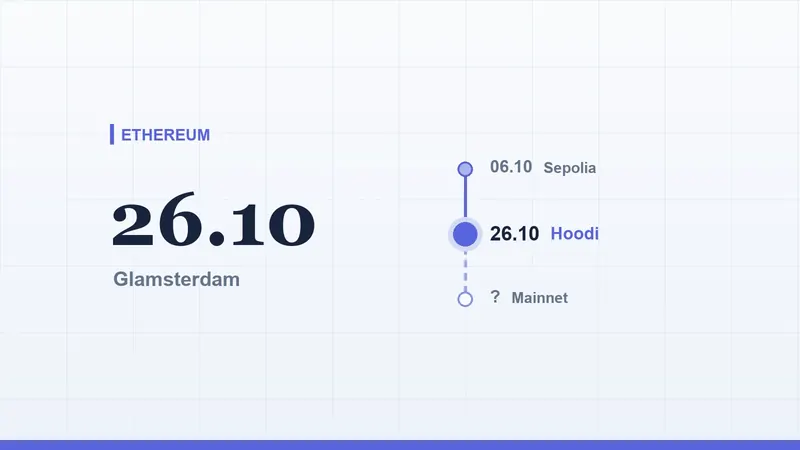
Glamsterdam, the next Ethereum upgrade, has been running on the Sepolia test network since 6 October. On 8 October the developers fixed the next step: the Hoodi test network upgrades on Monday 26 October 2026 at 17:42 UTC (18:42 CET). There is no date yet for mainnet, the live chain. In September the Ethereum Foundation was planning for December 2026.
Glamsterdam in short
- Hoodi: Monday 26 October, 17:42:48 UTC. That is what the network's configuration says.
- Mainnet: no date. The Hoodi proposal lists 1, 8 and 9 December as possible slots; nothing has been decided.
- Holders and stakers: you do not need to do anything. If you run your own node or validator, you need to update.
- What changes: blocks are built differently (ePBS), nodes can process a block in parallel, and gas is repriced. On Hoodi the gas limit goes from 60 to 200 million at the fork.
- Costs: a plain ETH transfer stays at 21,000 gas. To an address that does not exist yet, it becomes 204,600 gas.
- Europe: European exchange-traded products on ETH cost 0% to 1.49% a year.
Glamsterdam date: the schedule
Client teams, the makers of the node software, must release their Hoodi versions by Friday 16 October. That gives node operators ten days to update. Lodestar released version 1.50.0 on 12 October and calls it mandatory for Hoodi. The versions from all teams will appear in an Ethereum Foundation blog post.
Mainnet will get a separate announcement. In a blog post on 7 September the Ethereum Foundation worked with ‘December 2026’. The Hoodi proposal lists three possible slots: 1 December at 20:38 UTC, 8 December at 16:29 UTC and 9 December at 19:47 UTC. What has been agreed is that the higher gas limit takes effect on mainnet at the moment of the fork.
Today, 15 October, Glamsterdam is on the agenda of the consensus call ACDC #189 at 14:00 UTC (16:00 CEST). At the time of writing, no notes had been published.
What the Glamsterdam upgrade changes
The name combines Gloas, the consensus-layer part, with Amsterdam, the execution-layer part. Eighteen proposals (EIPs) are scheduled for the upgrade, plus five for traffic between nodes.
Block building in the protocol (EIP-7732, ePBS). Validators can currently have their block made by specialised builders; that exchange runs through intermediaries that both sides have to trust. With ePBS, Ethereum handles the exchange itself. The builder first commits to a block and an amount, the validator includes that commitment, and then the builder reveals the contents. The protocol handles the payment. This gives validators more time to check the contents.
Block-level access lists (EIP-7928). Every block gets a list of the accounts and storage locations it touches, with their values afterwards. Nodes can then read data from disk at the same time and check transactions in parallel.
New gas prices. Gas is the unit used to price transactions. Putting new data on the chain becomes more expensive (EIP-8037), and so does reading data: the first touch of an account goes from 2,600 to 3,000 gas (EIP-8038). EIP-7976 and EIP-7981 shrink the largest possible block by 37% and 21%. According to the Ethereum Foundation, these prices were last adjusted in 2021, and the repricing is needed to roughly triple capacity.
Gas limit. On mainnet a block can currently hold 60 million gas. On Sepolia the recommended limit has been 200 million since the fork; on 15 October it stood at 199.4 million. Hoodi's configuration says 200 million. No figure for mainnet is in a configuration yet.
Also. Every ETH transfer gets a log entry, contracts can be 64 KiB instead of 24 KiB, and SELFDESTRUCT no longer destroys ETH. About four times as much stake can leave staking per epoch, which should shorten the exit queue (EIP-8061).
What has changed since June
In June our earlier explainer, Ethereum's 'Glamsterdam' upgrade: what changes?, said Glamsterdam was expected in the second half of 2026. In July we followed with Ethereum closes three red quarters: is this the bottom?. Since then:
- The contents are fixed. In mid-June, 10 EIPs were scheduled. On 5 August the developers scheduled the rest of the candidate list; one was dropped afterwards. There are now 18.
- The repricing has been tested. On 24 August the Ethereum Foundation published a search tool for contracts that the new gas prices could break. According to the foundation, nothing changes for most transactions.
- The first testnet is done. ‘It was a boring fork’, Barnabas Busa of EthPandaOps, the team that runs the test networks, said of Sepolia. On 12 October the same team reported that the network was running stably.
- The schedule is more concrete. From ‘second half of 2026’ to a fixed date for Hoodi and December as the plan for mainnet.
Do you need to do anything?
You hold ETH. No. ‘As an Ethereum mainnet user or ETH holder, is there anything I need to do? No’, the Ethereum Foundation writes. According to the foundation, updated wallets and services handle the new gas prices.
You stake through a platform or an exchange-traded product. Nothing either: the provider runs the software.
You run your own node or validator. Update both your execution client and your consensus client, and as a validator also your validator client, before the fork. For Hoodi the versions are due by 16 October; for mainnet they come later. Check your disk too. The recommendation in EIP-7870 currently says about 500 MB/s. On 12 October the developers agreed to update that recommendation; developer Jochem Brouwer mentioned 2,000 MB/s. The text has not been changed yet.
Costs and speed for users
Speed. Glamsterdam does not make blocks faster: block time stays at 12 seconds.
Space. At 200 million gas, a block holds more than three times as much as now. More space can push down the price per unit of gas if demand stays the same. That is not guaranteed, and the Ethereum Foundation's announcements give no percentage for lower costs.
What gets more expensive. Today every plain ETH transfer costs 21,000 gas. After Glamsterdam that stays the same for an existing address. To an address that does not yet exist on the chain, it becomes 21,000 plus 183,600 gas (EIP-2780). For a new storage slot in a contract, such as the first balance of a token at an address, the surcharge goes from 20,000 to 97,920 gas.
An example. On 15 October at 12:55 UTC the base price was 0.26 gwei. A plain transfer then cost just over 1 euro cent, without a tip for the block builder. At the same price, a transfer to a new address after Glamsterdam costs about 11 euro cents. The base price changes with every block.
Ethereum price and what you can do in Europe
On 15 October at 12:58 UTC, ETH cost 2,095.64 euros, or 2,348.58 US dollars (CoinGecko): 5.7% less than a day earlier and 8.7% less than a week earlier. Over the past thirty days the daily price ranged between 2,078 and 2,422 euros. You can convert amounts with our converter. We do not give an Ethereum forecast or price target.
European exchange-traded products on ETH. Read on 15 October at four issuers:
21Shares and CoinShares describe their product as a debt security of the issuer, with ETH as collateral. You can lose your entire investment, CoinShares writes in the key information document for ETHE (risk class 6 out of 7).
Buying and staking ETH. At the platforms with a MiCA authorisation that we follow, this is what we saw on 15 October:
- Kraken: ETH/EUR; staking on its pages for EU countries such as the Netherlands, Germany and France at 2.55% a year, bonded.
- Finst: ETH for euros; staking at 1.55% a year with no lock-up. Finst states that this service currently falls outside the MiCA rules.
- eToro: ETH; staking only after a separate opt-in for ETH. You get 45% to 90% of the rewards, depending on your club tier.
- Crypto.com: ETH/EUR; ETH is on the European staking page, at an estimated 2.23% a year.
- OKX and Bybit: ETH/EUR on the European site; we could not confirm ETH staking without logging in.
Percentages change and are not a promise. Authorisations are in our register of authorisations, costs on our comparison page, and how staking works in our explainer.
What is not certain yet
- The mainnet date. It only follows after Hoodi. The three December dates are options.
- The block builders. On 8 October four to five builders were active on Sepolia. ‘Really, the big players are not yet on Sepolia’, said Barnabas Busa. Whether large builders will take part on Hoodi is not known.
- The short run-up. Staking pools and home stakers run on Hoodi. Give them less than two weeks between release and fork, and potuz of the Prysm client expects problems. For Sepolia, most clients still shipped a patch release just before the fork. He asked for a setting that lets validators fall back to trusted builders or their own block building if things go wrong.
- The costs. Whether transactions get cheaper depends on demand. Some actions become more expensive.
This article is not investment advice. Crypto can fall sharply in value and you can lose your entire stake.
Disclosure: the links to these platforms on our partner pages belong to our partner programmes. If you sign up through one of those links, CryptoCode receives a commission; you do not pay more.
Frequently asked questions
When will Glamsterdam reach mainnet?
There is no date yet. Hoodi upgrades first, on 26 October. In September the Ethereum Foundation was planning for December 2026.
What is the Glamsterdam date for Hoodi?
Monday 26 October 2026 at 17:42:48 UTC, 18:42 CET.
Do I need to do anything with my ETH?
No. Only if you run your own node or validator do you need to update the software.
Will Ethereum get cheaper?
Blocks get more space, but some actions become more expensive. The Ethereum Foundation has not given a percentage for lower costs.
Sources
Read on 15 October 2026.
- EIPs: EIP-7773 (Glamsterdam), EIP-7732, EIP-7928, EIP-2780, EIP-8037, EIP-8038, EIP-8061, EIP-7870.
- Ethereum Foundation: testnet announcement, repricing, priorities.
- ethereum/pm: Hoodi proposal, ACDT #100, ACDC #189.
- Call of 8 October: transcript on Forkcast, summary on Ethereum Magicians.
- Hoodi configuration, Lodestar v1.50.0, EthPandaOps.
- Our own measurement through public nodes from publicnode.com, 15 October 2026, 12:55 and 12:59 UTC.
- CoinGecko, thirty-day price series.
- Issuers: 21Shares, Bitwise, CoinShares, VanEck.
- Platforms: Kraken, Finst, eToro, Crypto.com.