

Bitcoin price falls after US inflation hits 3.7%
US inflation rose to 3.7% in September and bitcoin fell to 80,522 dollars. What the figures mean, and what you see in euros.
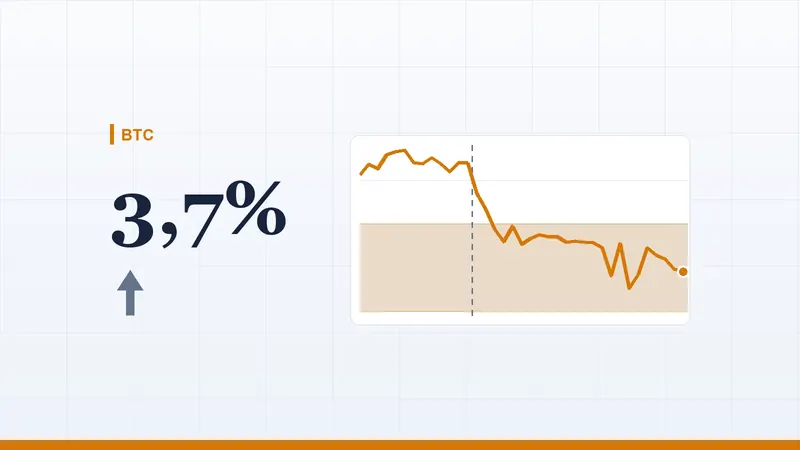
US consumer prices in September were 3.7% higher than a year earlier, the US Bureau of Labor Statistics (BLS) reported on 14 October. In August the figure was 3.4%. Half an hour before the release, bitcoin cost 83,391 dollars (12:00 UTC); it fell to 80,522 dollars on 15 October at 06:00 UTC. At 12:55 UTC it stood at 80,751 dollars, or 72,086 euros.
Bitcoin price and inflation in short
- 3.7%: US inflation for September. Economists had expected 3.6%, according to a Reuters poll.
- The surprise was in the core: excluding food and energy, prices rose 0.3% in a month, against an expected 0.2%. Over the year that is 2.6%.
- Bitcoin: 3.2% lower than on 14 October at 12:00 UTC, in dollars and in euros.
- Ether: below 2,500 dollars since 14 October 13:00 UTC; 2,354 dollars on 15 October at 12:55 UTC, 5.9% lower.
- ETFs: on 14 October, US bitcoin ETFs lost 261.4 million dollars, ether ETFs 129.5 million and Solana ETFs 1.3 million.
- Interest rates: on 15 October the market put the chance of a Fed rate hike on 28 October at 33.8%.
- Europe: euro area inflation in September was 3.8%, according to a first estimate.
What the inflation figures say
The BLS consumer price index (CPI) measures the prices paid by households in US towns and cities.
Monthly figures are seasonally adjusted. The expectations are those of economists as reported by Crypto Times, including a Reuters poll.
Petrol prices rose 9.1% in September and, according to the BLS, accounted for more than half of that month's increase. Energy as a whole cost 20.4% more than a year earlier. The monthly figure of 0.6% was expected. What surprised investors was core inflation: it leaves out energy and food and is therefore seen as a gauge of how persistent inflation is.
Why bitcoin reacts to US inflation
Bitcoin itself pays no interest. When inflation rises, the Federal Reserve (Fed), the central bank of the United States, can raise interest rates or keep them high for longer. Savings and government bonds then pay more, the dollar often strengthens and less money flows into assets that pay no interest or carry a lot of risk. That link is not a law. In July it went the other way: Bitcoin climbs to 65,000 dollars as US inflation comes in soft.
On 16 September the Fed raised the target range for its policy rate by 0.25 percentage points to 3.75 to 4.00%, by 12 votes to 0. In July three policymakers already wanted that: Fed holds rates steady, but three governors wanted a hike. Thomas Wu, chief financial officer of the bitcoin lender Ledn, told The Block that the hotter core inflation puts an October hike back on the table.
What the market expects can be seen in CME FedWatch, which derives probabilities from the prices of futures on the US policy rate. On 15 October at around 13:00 UTC, FedWatch gave a 66.2% chance of unchanged rates at the 28 October meeting and 33.8% for a 0.25-percentage-point hike. A cut got 0%. A week earlier, on 8 October, the chance of a hike was still below 20%, according to FedWatch's comparison chart.
Price, ETFs and the zone around 80,000 dollars
Hourly prices from CoinGecko:
In the thirty days to 15 October, bitcoin traded between 75,384 dollars (15 September) and 87,158 dollars (23 September).
US exchange-traded funds (ETFs) on bitcoin saw 261.4 million dollars leave on 14 October, mainly from Fidelity's FBTC (152.7 million) and BlackRock's IBIT (110.9 million), according to Farside Investors. In the week of 5 to 9 October the total was 678.9 million. Ether ETFs lost 129.5 million dollars on 14 October. Solana ETFs lost 1.3 million, their eighth trading day of outflows in a row.
Analysts point to the zone between 80,000 and 82,000 dollars. Matt Mena of 21Shares told The Block that bitcoin had already fallen back to 81,000 to 82,000 dollars last week, so much of the decline was already priced in. On 15 October at 06:00 UTC bitcoin was below that zone. We do not publish a price prediction.
What does this mean for you as a European investor?
The price in euros. Bitcoin is traded worldwide mainly in dollars. What you see in euros is the dollar price converted at the exchange rate. Over the past day that made little difference: 3.2% lower in dollars and in euros. Over thirty days it did: from 15 September to 15 October bitcoin rose 5.0% in dollars and 8.2% in euros. Over the same period the euro slipped from 1.1551 to 1.1195 dollars, 3.1% less (ECB reference rates of 14 September and 14 October). A stronger dollar makes bitcoin more expensive in euros; a stronger euro does the opposite. We described that second layer back in August: Bitcoin slips ahead of the US inflation reading. You can convert amounts with our converter.
Inflation in Europe. Euro area inflation was 3.8% in September, after 3.2% in August, according to Eurostat's first estimate of 2 October. Energy cost 18.8% more than a year earlier; excluding energy, food, alcohol and tobacco it was 2.5%. The European measure (HICP) and the US CPI are not built the same way, so compare them with care.
Poland and Denmark are not in the euro area and are not included in the first estimate. In August inflation there was 3.5% and 2.0%.
The ECB. The European Central Bank raised its three key rates by 0.25 percentage points on 10 September; the deposit facility rate has been 2.50% since 16 September. The ECB pointed to the conflict in the Middle East, which keeps pushing up inflation.
Buying or selling. Which platforms hold a MiCA authorisation is listed in our register of authorisations. What they charge is on our comparison page.
The next dates
What is not certain yet
- The Fed's decision. FedWatch works from futures prices; it is not a forecast by the Fed itself. The probabilities change every trading day.
- The expectation. Not every source gave the same expectation. Crypto Times cited a Reuters poll at 3.6% and a Truflation report that called 3.7% the market expectation.
- The European figure. The 3.8% is an estimate. Eurostat publishes the final figure on 16 October.
- The lowest price. CoinGecko gives hourly prices. Within an hour bitcoin may have traded below 80,522 dollars.
- The cause. Not everything is down to the inflation figure: on 7 and 8 October, a week earlier, 729 million dollars had already left the bitcoin ETFs.
- ETF flows for 15 October. These were not yet known at the time of writing.
This article is not investment advice. Crypto can fall sharply in value and you can lose your entire stake.
Frequently asked questions
Why does bitcoin fall when US inflation rises?
Higher inflation makes a higher, or longer-lasting, Fed rate more likely. Interest-bearing investments then become more attractive and the dollar often strengthens. Bitcoin pays no interest and often sees less demand as a result. That link does not always hold.
When does the Fed decide on interest rates?
On 28 October 2026, after a two-day meeting. The target range is currently 3.75 to 4.00%.
Is inflation lower in Europe?
No. In the euro area it was 3.8% in September according to the first estimate, 3.0% in the Netherlands and 4.6% in Belgium. The European and US measures are not fully comparable.
What does the dollar rate mean for my bitcoin in euros?
If the euro falls against the dollar, your bitcoin is worth more in euros at the same dollar price. From 14 September to 14 October the euro fell 3.1% against the dollar.
Sources
Read on 15 October 2026.
- BLS: consumer prices, September 2026, news release of 14 October, and the index series via the BLS data API.
- Federal Reserve: decision of 16 September 2026, meeting calendar.
- CME Group: FedWatch, 15 October 2026 at around 13:00 UTC.
- ECB: decision of 10 September 2026, key interest rates, meeting calendar, reference rates.
- Eurostat: first estimate for September, 2 October 2026; August inflation, 17 September 2026.
- CoinGecko: hourly prices for bitcoin and ether, retrieved on 15 October at 12:55 UTC.
- Farside Investors: ETF flows for bitcoin, ether and Solana.
- The Block, 14 October 2026: Thomas Wu (Ledn) and Matt Mena (21Shares).
- Crypto Times, 14 October 2026: economists' expectations.